Breadcrumbs Episode 5: Compassion and the Womb of God
Learning how a Hebrew word for womb cracked open my theology of God — showing you where I tattooed it on my body.
First Look at My New Tattoo
About 6 weeks ago I got a new tattoo. You’re the first ones to see it publicly!
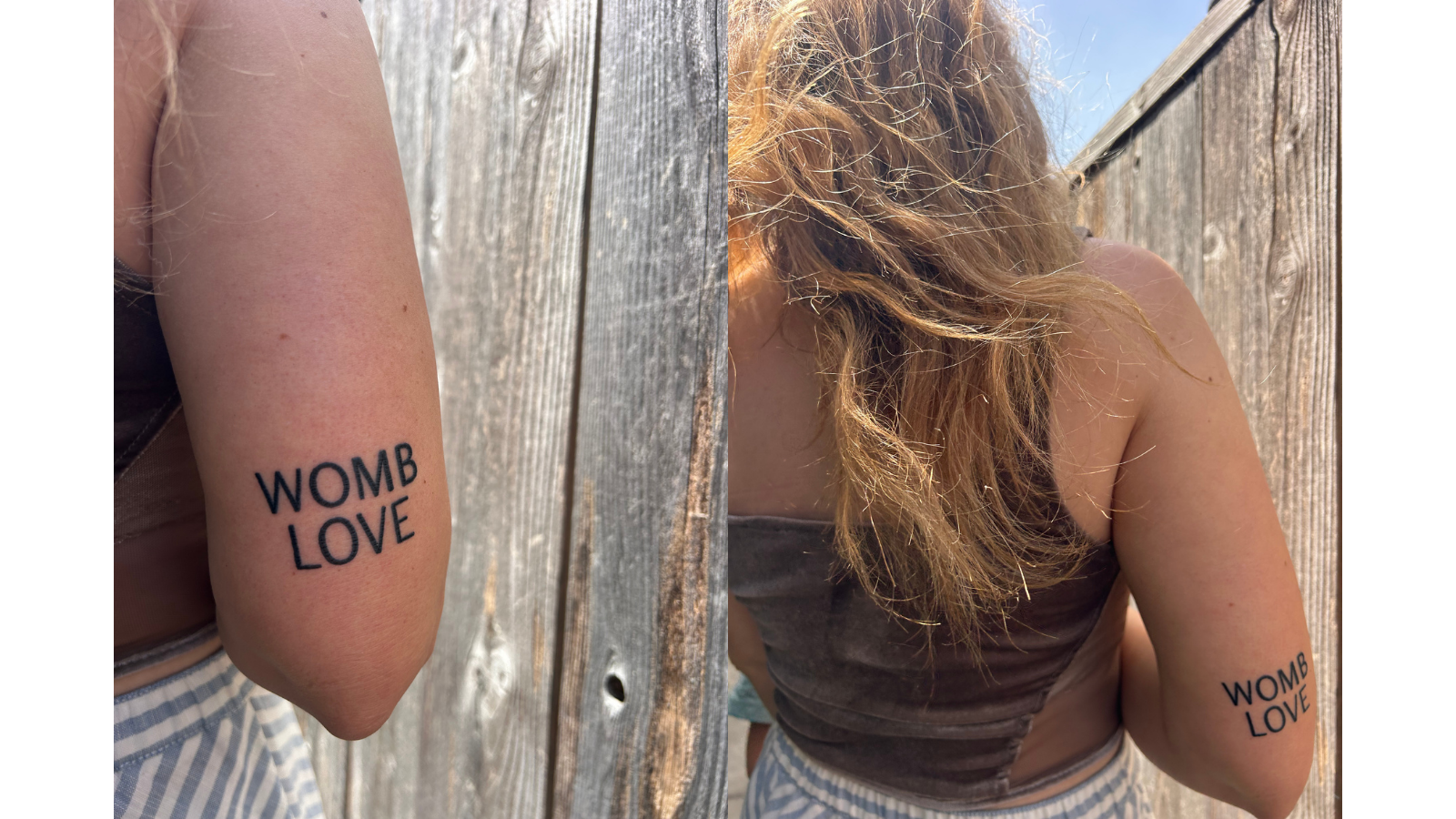
"Womb love" comes directly from the theology at the heart of Chapter Five of Faithfully Dissident Daughters. The first word God ever uses to describe Godself is the Hebrew word racham. Our English Bibles often translate it as compassion, mercy, tenderness, but it has a root word that means womb and evokes a maternal sense of care.
I put it on my body because seeing God through the primary lens of compassion has transformed my faith and the way I engage theology.
Standing at a Door, Afraid
In January of 2018, my twins were barely three months old and I created the space to attend a day-long yoga retreat. The theme was the creative energy of the divine feminine — which feels almost too on the nose now, looking back.
I found my journal from that day recently. I had written down three areas I wanted to channel more creative energy into. One of them was crafting a grounded, authentic spiritual practice. Then I wrote a list of what was standing in the way — and I circled the word fear.
I was afraid that if I kept following these threads, I'd lose what little connection remained to my old version of faith. I had stepped out of white evangelicalism a few years earlier which had been disorienting and grief-filled. Yoga and meditation were keeping me spiritually alive, but still wasn’t sure how to read the Bible and engage my own tradition. I needed to find out how to be a Christian in a different way, but I was standing at a door I wasn't ready to walk through. There were still years and levels of honesty I needed to cut through to face the truth of myself and my life.
The Year I Stopped Blurring the Edges
In 2018 I was mostly keeping my head above water, and in 2019 I felt like I was drowning. At the beginning of 2020, I decided to do a fully sober year (I know, lol). I had been reading Laura McKowen's We Are the Luckiest and Holly Whitaker's Quit Like a Woman — both leading voices in the feminist sobriety movement — and something cracked open. I wrote in my journal that February: "Alcohol doesn't make hard moments easier. It just makes me less present to them. It's a false buoy that deflates and leaves me drowning in deeper water than before."
What I didn't know was that a pandemic was coming the following month.
Sobriety in 2020 meant I couldn't blur what was coming. It meant I had to face the pain of my life directly, on the pages of my journal, in my body, in the rhythms of my every day life.
Birth and Death in the Same Week
In April of 2020, still in the early disorienting days of the pandemic, I found out that my best friend Rebecca's cancer had returned. It had spread to her spine, her lungs, her liver, her brain.
The entire experience of Rebecca’s cancer and ultimate death was a liminality I lived inside for nearly 4 years. She was dfirst iagnosed with breast cancer the month before my twins were born. The same week they arrived, she started chemo. And then in March of 2021, she died just a couple of weeks after my niece was born. I saw Rebecca in her final days, and then I flew to hold a new baby.
Birth and death are the same threshold. The theology of womb love — of a God who holds both in her very body, just like I have — came from being inside that space in my life.
I share two journal entries from 2021 in this episode. One from August, five months after she died, where I write about resisting acceptance — "feelings make her real, and acceptance feels like the final nail in the coffin." And one from September, where I write honestly: "I don't know what I believe about death."
The Tomb Became a Womb
This past Easter, I got to preach in my little faith community. I talked about how I learned from Christena Cleveland to see the tomb of Jesus — the place of death, of endings — as a womb. The resurrection is an embodied symbol of a divine pattern: in every ending, there is a new beginning. Death and rebirth. Over and over.
I opened this episode with womb love on my arm, and I closed it there too. Because I did walk through that door I was afraid of in 2018. It cost something — deep depression, sobriety, fighting for what felt like my very survival. But what I found on the other side was a God with a womb. Compassion as the center. A theology expansive enough to hold all of it.
Next month, Episode 6 of Breadcrumbs will go behind the scenes of Chapter Six: Sacred Body, Sacred Emotions. See you there.