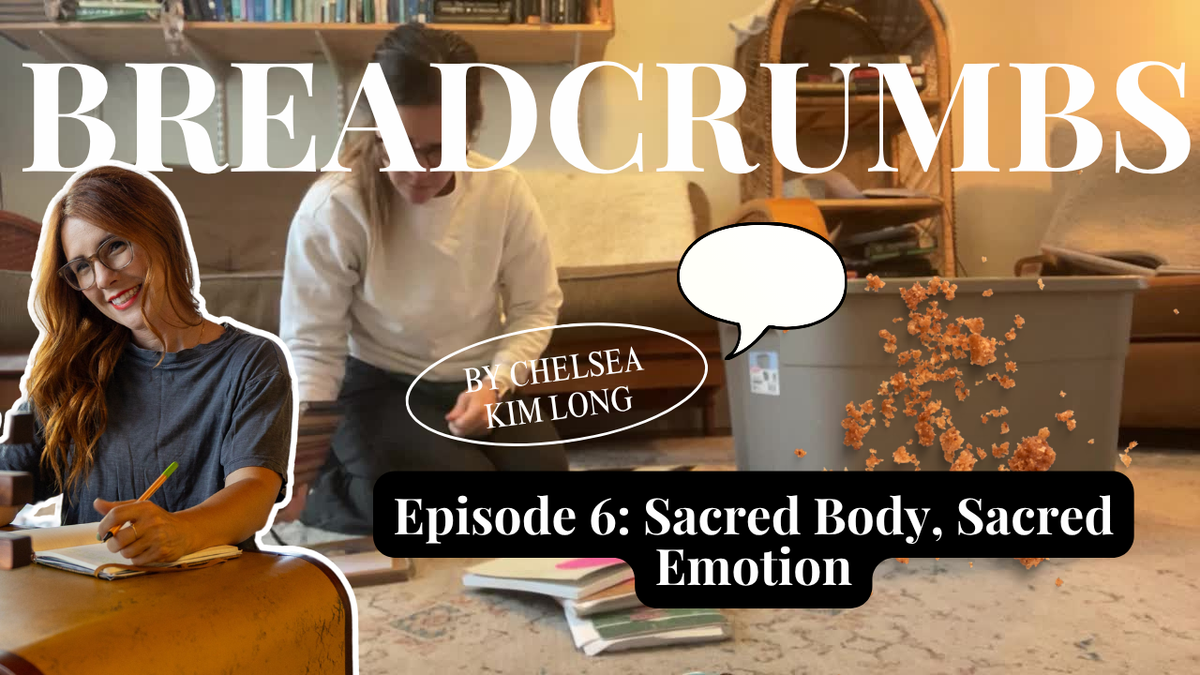
Breadcrumbs Episode 6: Sacred Body, Sacred Emotions
Learning how a yoga teacher training, a baby penguin, and medieval art all point to the same theology — your body is not a liability to faith. It's your first site of connection with God.
My Proof Pages Arrived!
Before I get into the episode — I got my proof pages back! For the non-publishing people: this is when the book gets laid out in the actual design program, with real page numbers and chapter titles, looking exactly like it will when it goes to print. My job now is to read it one more time and catch any remaining typos before it goes to the printer.
It looks like a real book. September 8th is 4 months away and it’s feeling very real.
The Chapter My Editor Helped Shape
Chapter Six is called Sacred Body, Sacred Emotions, and it traces how women have been taught to see our bodies as liabilities and our emotions as untrustworthy — and makes the theological case that both are actually sacred.
This is one of the chapters where my editor Jessica had the biggest impact. Several times she'd come back with a comment that was essentially: "Wait — can you explain this more?" The most memorable was when I wrote a brief aside about how our entire culture is structured around a 24-hour male hormonal cycle. Her comment came back: "What?! I've never heard of this. Can you explain a little more?"
I had to stop myself from writing ten more pages.
The YTT Season
In 2016, while I was going through fertility treatments, I was also doing my 200-hour yoga teacher training. The juxtaposition was almost absurd — learning to honor my body in class, injecting hormones into my stomach in the evenings.
I found my YTT ethos statement from that season:
"I am a teacher who embodies freedom by practicing vulnerability. I own who I am and teach from that place. My desire to connect with God inspires my passion for yoga and I work to help others connect with God and each other."
I made a map of myself in 2016 and spent the next ten years writing my way through every single item on it. I wrote that silence was one of my biggest obstacles. I already knew my own silence was standing in my way, but it still took me a long time and a lot of heartache to get out from under it.
The Grief Journal from 2009
I found a journal entry from May 2009 — just after graduating college, at the missions trip training camp where I met my husband. They asked us to write about our grief. I wrote about my senior year of high school at my Christian school, the social consequences of not falling in line, the ways I felt stifled.
Reading it now, I can see how far I still had to go. But I can also see that even then, something in me knew.
That sent me to the song we used to sing based on Psalm 51, "Create in Me a Clean Heart." David's prayer after his worst moment. The irony: a psalm about God wanting truth in the inward parts, sung in a culture that taught me to suppress my inward parts.
Cycle Syncing and the Editor Exchange
The section on cycle syncing — aligning your life around your hormonal cycle rather than the 24-hour male cycle the rest of the world runs on — is one my editor asked me to expand. I draw from Alisa Vitti's work in In the FLO, and the basic premise is this: women's bodies don't reset every 24 hours. Our energy, focus, social capacity, and intuition shift across a 28-day cycle — and we've been judging ourselves for not performing to a standard our bodies were never designed to meet.
The Baby Penguin
Internal Family Systems is a therapeutic framework my spiritual director introduced me to, and it's changed how I relate to my own inner life. The premise: every part of you — even the difficult ones — is trying to protect you. Nothing needs to be suppressed. Every emotion has something to say.
In one solo IFS practice, deep in grief over losing Rebecca, I tried to let my grief take a shape. It showed up as a big, slippery, kind of repulsive penguin. But when I kept with it and brought compassion rather than resistance, the big scary penguin transformed into a fluffy baby penguin, small and helpless and actually kind of lovable.
From then on, when grief came up, I had something I could hold with tenderness instead of brace against.
The Medieval Vulva Art
Last fall I was in New York City and visited the Cloisters — the part of the Met Museum dedicated to medieval art. They had an entire room on medieval art and sexuality, and in one ornate prayer book belonging to a wealthy medieval Christian, there was an illustration of the side wound of Christ that looked unmistakably like a vulva.
I write about this in the chapter with some humor — but the theological point is serious. Medieval Christians understood the body in ways we've buried. The parts we've been taught to hide in shame were once used to image the sacred.
What It All Points To
Every spiritual experience you have ever had has happened inside your body. That's the through line of Chapter Six. The body isn't an obstacle to faith — it's the location of faith. Eugene Peterson's translation of 1 Corinthians 6 says it simply:
"Let people see God in and through your body."
I used to think my body was a liability to faith. Now I know it's my first site of connection with God.
The full video Episode 6 of Breadcrumbs is available to paid subscribers. Next month, Episode 7 of Breadcrumbs will go behind the scenes of Chapter Seven.