
The Witch of Endor Wasn’t a Witch | 1 Samuel 28
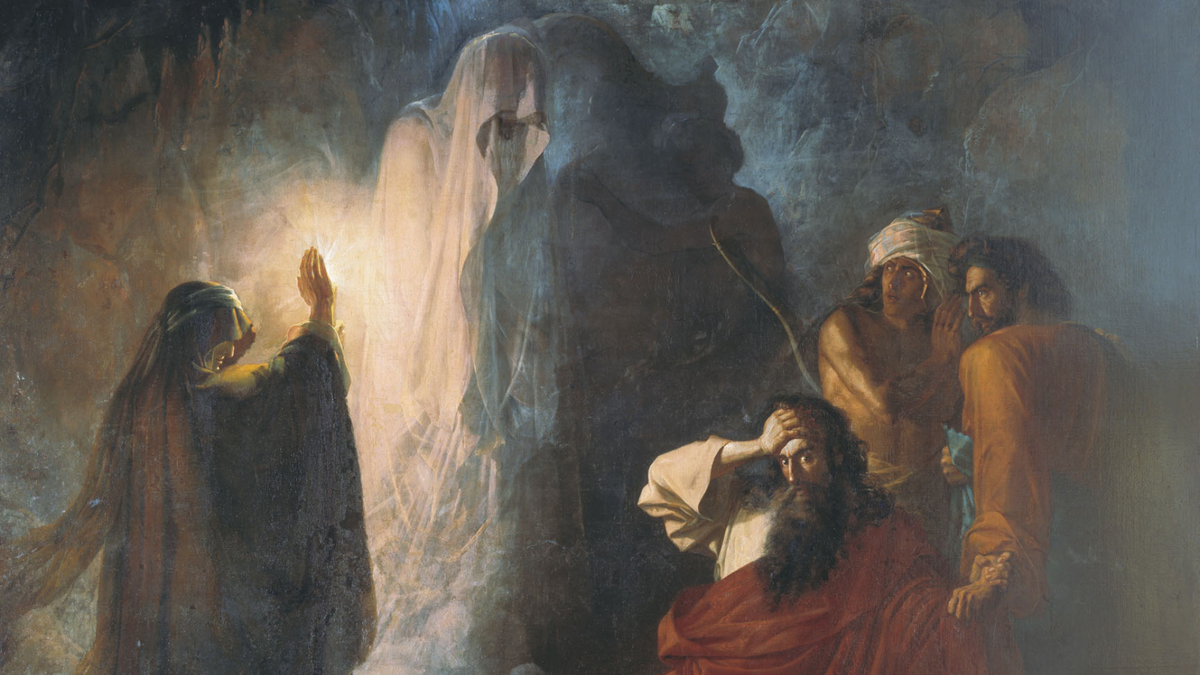
The "witch of Endor" is an unnamed woman in 1 Samuel 28 whom King Saul visits to call up the dead prophet Samuel. The Hebrew never calls her a witch. It calls her a ba'alat-'ov, a "ghost-master" in Rev. Dr. Wil Gafney's translation, and the story ends with her baking bread for the king who had banned her.
Join us on All Souls’ Day, Monday, Nov 2, for a free circle around her.
Why her, why now
I grew up being taught to fear witches. I was, somehow, allowed to read Harry Potter, but other than that, any interest I had in anything around witches or the occult was promptly squashed. I have a clear memory of being at the thrift store with my mom and picking up a copy of Roald Dahl's book The Witches, asking my mom if I could buy it. She immediately said no, and I felt a sense of disapproval that I had even asked. And then I grew up to realize that some of the women called witches throughout history were healers, midwives, and wise women who challenged patriarchal power, and many more were simply poor, old, or inconvenient women someone wanted gone.
This month's story is found in 1 Samuel 28. Saul comes to this woman at night, in disguise, after he has driven people like her out of the land, and he asks her to call up the prophet Samuel. She realizes who he is in the middle of it. When Samuel's words leave the king face down on the floor, she is the one who notices he hasn't eaten all day. She kills a fattened calf, bakes bread, and feeds him.
In a 2023 sermon, Rev. Dr. Wil Gafney calls her the "not-a-witch" of Endor. Nowhere in the text is she called a witch, and nowhere does she practice witchcraft, but she does have a power the men around her don't. Gafney points out that the woman whose life Saul holds in his hands is the only one in the story who shows him kindness.
The meal she makes echoes some of scripture's most important tables. Like Abraham, who hurries to bake bread and prepare a calf for three strangers at Mamre, she treats a dangerous guest with extravagant hospitality. Like the Israelites at the first Passover, Saul eats unleavened bread at night, in haste, on the eve of death and deliverance. A forbidden woman's kitchen becomes a last supper.
Theologian and author Marg Mowczko noticed that this story opens with almost the same line as Abigail's in 1 Samuel 25: Samuel has died. She wonders whether these two women picked up the prophetic work he left behind. Both risk their lives, both confront a king the truth with tact, and both feed him. And she names the irony: the law says a medium must die, but in this story she lives, and it's Saul who dies.
I never heard of All Saints' or All Souls' growing up evangelical. Connecting with the dead was the stuff of mediums, who were demonic, full stop. What I didn't know is that Christians remembered their dead together for most of church history. The Reformation cut most of those ties: when the reformers abolished purgatory, All Souls' Day went with it. Liturgical churches slowly brought some of it back (the Episcopal Church put All Souls' in its prayer book in 1979), and churches like mine, which didn't keep the church calendar at all, never did. Gafney points out in her lectionary that many peoples, including African, Afro-Caribbean, Asian, and other Indigenous communities, have always spoken to and remembered their holy dead and their ancestors, and that missionaries persecuted those practices even while the church kept its own communion of saints.
Gafney also notices that the word for Samuel's robe in verse 14 is the same word used for the little robes his mother, Hannah, sewed for him every year when he was a boy (1 Samuel 2:19). I can't stop thinking about that: the prophet comes up from the dead still wrapped in his mother's love.
All Souls' Day is the church's day for remembering the ordinary dead, the ones who never made it onto a saints' calendar. It feels right to spend it with a woman the story never names, who sat with grief and death in her own house and still fed the powerful person in front of her.
So I'm curious what you were taught about women like her. Who in your own family line was called too much, or dangerous, or simply got left out of the story? And what would it mean to set a place for them this year?
Where she is in scripture: 1 Samuel 28
1 Samuel 28:3–25. Samuel has died, the Philistines are camped at Shunem, and when Saul inquires of the Lord, "the Lord did not answer him, not by dreams or by Urim or by prophets" (v. 6). Saul, who had expelled the mediums himself (v. 3), disguises himself and goes to a woman at Endor by night. She asks why he is "laying a snare for my life" (v. 9). After Samuel's words leave him face down on the floor, she offers "a morsel of bread" (vv. 21–22). Then she gives far more than a morsel: "She quickly slaughtered [a calf], and she took flour, kneaded it, and baked unleavened cakes" (v. 24). All quotations NRSVue.
The Hebrew. Verse 7 calls her 'eshet ba'alat-'ov. Ba'alat is the feminine form of ba'al, "lord" or "master," and an 'ov is a ghost (some scholars think the word also meant the pit dug in the ground to call one up). So Gafney translates the phrase "a woman who is a ghost-master." Ghosts don't possess her; she commands them. "Medium" turns her into a passive vessel. The word "witch" isn't in the text at all. Mowczko points out that Hebrew has a separate word for sorcery, from the root kashaf (behind "sorceress" in Exodus 22:18), and 1 Samuel 28 doesn't use it.
In verse 13 she sees 'elohim, the usual word for God, coming up out of the earth, with a plural verb. NRSVue has "a divine being"; CEB "god"; NIV "a ghostly figure." In verse 15 Gafney reads Samuel's complaint as being shaken awake and dragged up from Sheol.
Her other appearances. 1 Chronicles 10:13–14 names Saul's consulting a medium as one reason he died. The laws she lived under forbid turning to mediums or consulting the dead (Leviticus 19:31; 20:6; Deuteronomy 18:10–12), and one goes further: a man or woman who practices as a medium is to be stoned (Leviticus 20:27). Notice who most of these laws target. It's the person seeking answers from the dead, which in this story is Saul.
Is she ever read in church? A lectionary is the set schedule of Bible readings a church follows on Sundays, usually in a three-year cycle. Catholics use the Lectionary for Mass, and many mainline Protestant churches use the Revised Common Lectionary, which was adapted from it. (Most evangelical churches, like the ones I grew up in, don't follow a lectionary at all.) Whatever a lectionary skips, most churchgoers never hear, and both of these leave out a lot of women's stories. That's why I often turn to two alternatives that bring them in: the Comprehensive Catholic Lectionary and Rev. Dr. Wil Gafney's Women's Lectionary.
- The Revised Common Lectionary skips her. Its Year B readings move from Saul's story straight on to David.
- The Comprehensive Catholic Lectionary, developed over about a decade by Catholic women priests Jane Via and Nancy Corran, adds women's stories the standard Sunday readings skip over and uses inclusive language for God and people. Even it doesn't include 1 Samuel 28.
- Wil Gafney's A Women's Lectionary for the Whole Church does. She appears in Year B on the Sunday closest to June 8 (Proper 5), and Gafney notes that her story might seem better suited to the Sunday closest to All Hallows' Eve.
Sources
Wilda C. Gafney, "They Call Us Witches: The Not-A-Witch of Endor," wilgafney.com, October 3, 2023. https://www.wilgafney.com/2023/10/03/they-call-us-witches-the-not-a-witch-of-endor/
Wilda C. Gafney, A Women's Lectionary for the Whole Church: Year B, Proper 5, pp. 216–17
Margaret Mowczko, "The Witch of Endor, the Dead Prophet, the Doomed King," margmowczko.com, April 19, 2018. https://margmowczko.com/witch-endor-prophet-samuel-king-saul/
On my bookshelf
In the Beginning Were the Women by Claire K. McKeever-Burgett
My friend Claire writes about the women of scripture with love and imagination, giving them names and a voice we don't often hear and pairs her chapter on this woman with a liturgy you can actually pray. If you've only ever met this woman as a cautionary tale, start there. Then go back and read the rest, slowly, maybe with a candle lit. She names the woman at Endor Eliora.
On Monday night, November 2, we'll gather around her, light candles for the women who came before us, and pray her story together. This one is open to all subscribers, free or paid, so bring a friend.
The circle
Monday, November 2 (All Souls' Day), 5 pm PT / 7 pm CT / 8 pm ET, on Zoom.
To prepare, if you'd like:
- Read 1 Samuel 28:3–25 in whatever translation you love
- Bring a candle, and a photo or object that honors a woman who has died
- Have a journal and pen nearby
We'll keep cameras on if you're comfortable, and stay unmuted but quiet, so the room feels more like an embodied community. If you can't make it live, the replay will be posted here by Wednesday.

Take it home
An Altar for the Cloud of Witnesses
For a kitchen table, a small group, or a church. Print it and keep it on the fridge for any day you're missing someone.
1. Set the altar. A candle. A photo or something of theirs. Something they made or loved to eat, or the bread your family typically makes.
2. Light the candle. God who nourishes us with unending compassion, you are the God of the living and the dead. We are surrounded by a great cloud of witnesses, and tonight we make a place for them.
3. Name them. Say each name out loud. After each one: We stand in the lineage of [name], and we give thanks for her life and witness.
4. Notice what lives on. Faith lived first in Lois and Eunice, and then it lived in Timothy (2 Timothy 1:5). What of her is still alive in you? A phrase she always said. The way you season the soup. Your hands, your stubbornness, your laugh. Say it out loud: What lived in you lives in me. If she left something heavy too, you can name that as well: This, I set down.
5. Pray for the quiet. When God is silent, let me remember who fed me. And make me bread for someone else.
This practice is written by Chelsea Kim Long. You're welcome to pray it aloud in your community and adapt it for use with credit to chelseakimlong.com.
If someone pushes back
Someone may point out that the law forbids mediums (Deuteronomy 18:10–12) and that Chronicles counts this visit against Saul (1 Chronicles 10:13). That's fair, and this circle isn't asking anyone to take up her practice.
Gafney points out that Deuteronomy forbids consulting ghosts or having a familiar spirit, and this woman does neither: she doesn't ask Samuel anything, she calls him up for someone else. If anyone broke that statute, it was Saul. Even Marg Mowczko, who calls the woman's profession evil, finds the story treats her with surprising sympathy. So we're noticing how the story itself treats her.
The story lets her speak for herself, and never once calls her wicked. She tells the truth while risking her life, and the prophet she calls up actually appears. Then she does the most ordinary holy thing there is and feeds a man who has given up. It's worth asking why that part got forgotten.
It also helps to separate consulting the dead from remembering them. Deuteronomy forbids going to the dead for answers. Remembering them, giving thanks for them, even sensing them near, is what Christians mean when they say "the communion of saints" in the Apostles' Creed, and it's the picture Hebrews 12:1 paints of a great cloud of witnesses surrounding us. Chronicles faults Saul for seeking guidance from a medium instead of from God (1 Chronicles 10:13–14), not for missing Samuel.
Keep going
- If you were also taught to distrust your body as a way of knowing God, start with Embracing Embodied Spirituality and Exploring Embodied Spiritual Practices in the Christian Tradition.
- Another thing evangelicalism told us to fear: Can Christians Do Yoga?
- More prayers and practices you can use at home or in your community: Liturgies and Faith Resources
- Meet Wisdom, the divine feminine in Proverbs: Learning to See Wisdom
- Want to books like Claire's in community? The Faithfully Dissident Book Club
- Every woman we've gathered around in the circle